
Public authorities, insurers and companies exposed to heat, floods and drought may soon share one assumption about how warm the world will get. On 27 October 2026, the European Commission proposed a European Climate Resilience Law within a new EU Framework for Climate Resilience. It sets a reference warming trajectory and requires a named public owner for each major climate risk. It is a proposal: Parliament and Council still have to agree it. Source: European Commission, Communication COM(2026) 720, 27 October 2026.
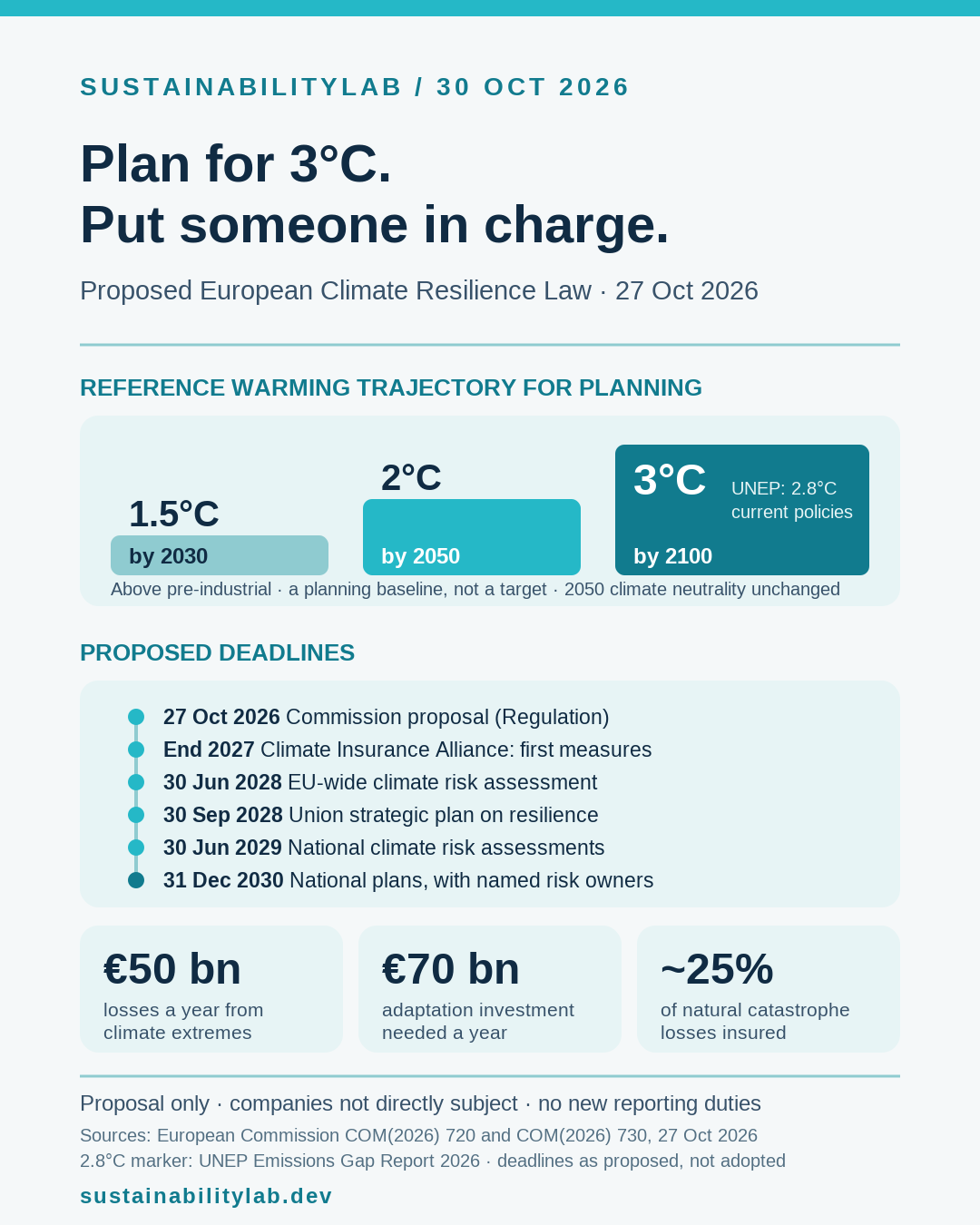
All figures and dates come from the Commission’s Communication and the proposed Regulation; the 2.8°C marker is from the UNEP Emissions Gap Report 2026. The visual shows a planning reference, not a forecast or a target, and deadlines are as proposed, not adopted.
What the Commission proposed
The core is a reference global warming trajectory. The Commission describes a plausible path to 1.5°C above pre-industrial levels by 2030, 2°C by 2050 and 3°C by 2100, and says it should be “the baseline assumption” for decisions on climate risk. The EU’s binding goal of climate neutrality by 2050 does not change. Source: European Commission, COM(2026) 720.
The proposed law is a Regulation, so it would apply directly in every member state. It sets deadlines: the European Environment Agency completes an EU-wide climate risk assessment by 30 June 2028, the Commission adopts a Union strategic plan by 30 September 2028, member states complete national risk assessments by 30 June 2029 and adopt a single national strategic plan by 31 December 2030. Each member state must name public authorities responsible for each major climate risk. Source: European Commission, proposed Regulation COM(2026) 730.
Losses from climate extremes have averaged about €50 billion a year over the past four years. Adaptation is expected to need about €70 billion a year in investment, and such investments usually return two to ten times their value in avoided damage. Only about 25% of natural catastrophe losses in the EU have historically been insured; a Climate Insurance Alliance is to deliver first measures by end-2027. Source: European Commission, COM(2026) 720.
Why a 3°C reference matters
A target says where emissions should go; a planning reference says which world infrastructure, budgets and insurance should be ready for. The Commission’s trajectory sits close to UNEP’s Emissions Gap Report projects 2.8°C by 2100 under current policies (covered last week). Source: SustainabilityLab, 23 October 2026.
The second shift is ownership. The Communication describes a move “from diffuse responsibility to a clear identification of risk owners”. A risk that belongs to everyone is often managed by no one; a named owner can be asked who assessed it and who pays. Source: European Commission, COM(2026) 720.
What it means for companies
The proposal does not regulate companies directly. Its explanatory memorandum states that “the private sector is not directly subject to the proposal” and that the Commission does not propose new reporting requirements. Source: European Commission, COM(2026) 730.
The indirect effect may still matter. The Communication says climate risks “should be adequately reflected in asset valuations and financial accounts” and that revised EU Taxonomy delegated acts will make resilience investments easier to identify. For physical risk reporting under ESRS E1 or IFRS S2, an EU reference offers a common benchmark to test scenarios against. Source: European Commission, COM(2026) 720.
Three questions help: Which warming scenario does our physical risk analysis use, and is 3°C by 2100 among them? Who in our organisation owns each material climate risk? Which of our assets would be uninsured after an extreme event?
Educational takeaway: A temperature target and a planning assumption are different tools. The EU keeps its 1.5°C-aligned climate goals while proposing that public planning prepare for 3°C.
Limitations: This is a proposed Regulation; its content and deadlines can change in negotiations between Parliament and Council, and nothing applies until it is adopted. The trajectory is a planning reference, not a forecast. We have not reviewed the proposal’s annexes or impact assessment, and we do not assess anyone’s readiness.
Other updates this week
Restoration reaches 252 million hectares · 29 October. UNEP, FAO and the CBD Secretariat report 252 million hectares under restoration in 149 countries, with funding needing to rise from $64 billion to $296 billion a year. “Under restoration” does not yet mean recovered; see our article on restoration beyond project boundaries. Primary source: UN News.
Greenhouse gases at new records · 27 October. WMO reports 2025 averages of 426.8 ppm carbon dioxide, 1,948 ppb methane and 339.1 ppb nitrous oxide. The warming effect of long-lived gases is up 56% since 1990. Primary source: WMO.
National pledges cut 2035 emissions by about 6% · 27 October. UNFCCC’s 2026 NDC Synthesis covers 127 new pledges from 154 Parties, about 70% of global emissions. Together they would cut emissions about 6% below 2019 by 2035, or about 9% if fully implemented, which UNFCCC calls substantially off-track. Primary source: UNFCCC.
Heat deaths rising, says Lancet Countdown · 27 October. Heat-linked deaths averaged 540,800 a year in 2016–2023, with 68% attributed to climate change, and heat cut potential income by $1.07 trillion in 2025. Figures are modelled. Primary source: The Lancet via EurekAlert.
COP17 ends with finance contested · 26–30 October. Over $1.8 billion in new biodiversity pledges were announced in Yerevan, but negotiators split on widening the group of contributing countries. Final decisions were not yet published at the time of writing. Primary source: CBD.
Ocean carbon monitoring gap · 28 October. A UNEP and UNFCCC report calls for investment in ocean observation and data, noting that ocean-based carbon removal “should complement emissions reductions rather than replace them”. Checked via secondary coverage only. Source: GreenTechLead.
Sources
- European Commission Communication COM(2026) 720 on the EU Framework for Climate Resilience, 27 October 2026 (Council register)
- European Commission proposal for a European Climate Resilience Law, COM(2026) 730, 27 October 2026
- SustainabilityLab on the UNEP Emissions Gap Report 2026, 23 October 2026
- UN News on the Restoration Progress Report, 29 October 2026
- WMO press release on the Greenhouse Gas Bulletin No. 22, 27 October 2026
- UNFCCC news on the 2026 NDC Synthesis Report, 27 October 2026
- EurekAlert release on the 2026 Lancet Countdown report, 27 October 2026
- CBD press release on COP17, 29 October 2026
- GreenTechLead on the UN ocean carbon intelligence report, 28 October 2026