
International climate texts change line by line before they are agreed, and the changes say a lot. The COP31 Presidency published a draft of the conference's main decision on 16 November and a shorter revised draft on 19 November. Comparing the two official texts shows what survived, what was removed and what was narrowed. Both are marked as unedited drafts. Talks ran past the scheduled close on 20 November into 21 November, and no final decision had been adopted when we published. Source: UNFCCC, 16 November draft · UNFCCC, 19 November draft
Update, 29 November 2026: COP31 closed on 22 November without adopting the cover decision. The 35% electricity goal did not reach any adopted text and now stands as a voluntary coalition. Read where each draft item ended up.
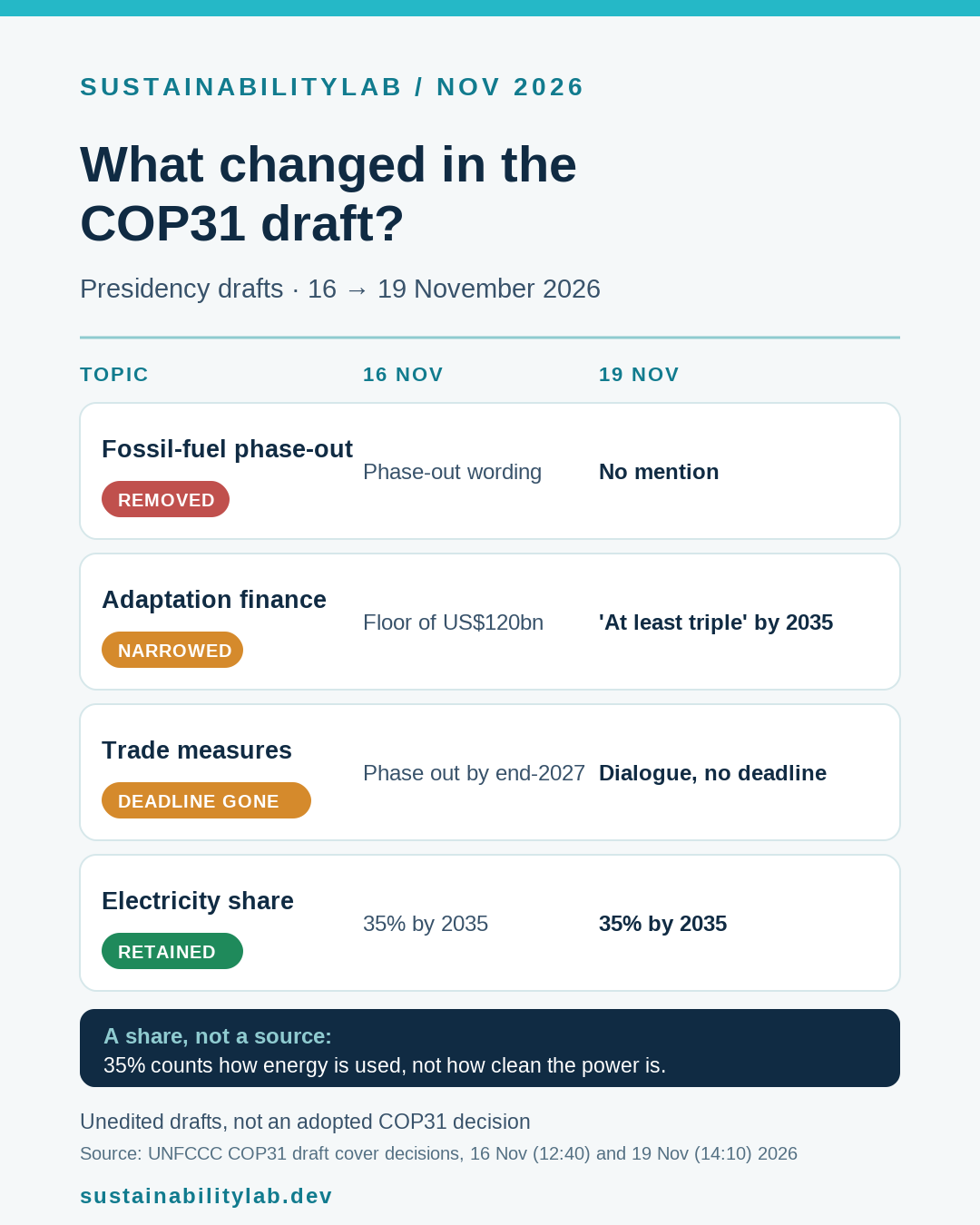
The visual compares two unedited presidency drafts, not an adopted decision.
Four changes worth understanding
1. Fossil-fuel wording disappears. The 16 November draft reaffirmed transitioning away from fossil fuels and, in a separate paragraph, called for "accelerated action to phase out fossil fuels". The 19 November draft does not mention fossil fuels by name; it refers only to "zero- and low-carbon energy technologies and fuels". This does not repeal the adopted COP28 global stocktake decision, which already calls for transitioning away from fossil fuels in energy systems. Source: UNFCCC drafts
2. The adaptation finance floor goes; the tripling stays. The first draft said tripling adaptation finance "should reach at least USD$120 billion". The revised draft keeps a call for efforts to "at least triple adaptation finance by 2035" without a figure. A separate US$120 billion a year in development-bank climate finance remains in the text, but that is a different number for a different purpose.
3. The 2027 trade deadline goes. The first draft called on developed countries to phase out unilateral climate-related trade-restrictive measures "by the end of 2027". The revised draft keeps general language on non-discrimination and a continuing dialogue on trade and climate, but no deadline. Measures like carbon border adjustments affect supply chains and market access, so this matters for exporters.
4. The 35% electricity goal survives. Both drafts ask countries to contribute, "in a nationally determined manner", to raising electricity's share of total final energy consumption to 35% by 2035, alongside tripling renewable capacity and doubling the rate of energy-efficiency improvement by 2030.
A share, not a source
The surviving goal counts how energy is used: how much of the energy that homes, vehicles and factories consume arrives as electricity rather than as fuel. It says nothing about how that electricity is generated.
That matters. Heat pumps, electric motors and electric vehicles are usually more efficient than the fuel-burning equipment they replace, but the emission cut depends on the power mix. Electricity from coal cancels much of the gain; electricity from wind, solar, hydro or nuclear delivers most of it. With the fossil-fuel wording removed, the draft describes where energy use should go but not what it should move away from. A rising electricity share is a good sign of structural change, but it needs a companion number: the clean share of the electricity being added.
Outside the negotiated text, the goal is backed by a voluntary Electrification Delivery Package presented on 19 November, listing action by more than 150 countries plus the EU, 37 cities and more than 260 businesses. It reports that UNEZA utility members built more than 21,000 km of new grid in 2025 and plan at least US$156 billion a year in grids, renewables and storage. These figures are self-reported, cover different periods and should not be added together. Source: UNFCCC, 19 November 2026
What it means for companies
The COP31 text is not a corporate regulation. Read it as a signal for scenario planning, and check four things:
- Electrification: what share of the company's energy use is electric today, and what is the target?
- Clean share: how is that electricity sourced (on-site renewables, power purchase agreements, certificates or the grid mix)? This decides the emission effect.
- Trade exposure: could climate-related trade measures affect sourcing, exports or market access?
- Policy assumptions: does the transition plan under ESRS E1 or IFRS S2 rely on wording that is still being negotiated?
A Nature Perspective published this week makes the same point for corporate targets: emissions targets often miss real business change, so the authors propose transition targets on concrete milestones such as electrification or low-emission materials. Source: Hans et al., Nature, 18 November 2026
Educational takeaway: A presidency draft is not consensus, a provisional agreement is not adopted law, and an adopted COP decision is not a company-level obligation. Track the version, the date and the legal stage before planning around a headline. And read any electrification target next to the clean share of electricity and the emissions result.
Limitations: We compared the two presidency cover-decision drafts only, not every negotiating track. Neither text was adopted when we published; if the final decision differs, we will update this article. Pledge figures are as reported by the organisers.
Other updates this week
EU agrees new categories for sustainable funds · 19 November. Council and Parliament reached a provisional agreement to revise the SFDR, creating three product categories (sustainable, transition and ESG basics), with a 70% test and ESG terms in fund names reserved for categorised products. It still needs formal adoption. SFDR covers financial products, not company reporting under the CSRD. Source: EU Law Live
CDP releases 2026 scores · 18–19 November. Scores went to disclosers on 18 November, with public scores due in the week of 30 November. All seven forest-risk commodities are now scored, including rubber, cocoa and coffee; plastics, biodiversity and oceans remain unscored. CDP notes its score reflects disclosure quality and maturity, not environmental performance. Primary source: CDP
Corporate targets need transition milestones · 18 November. The Nature Perspective above proposes transition targets beside emissions targets, for example the share of production using lower-emission processes. It is a research proposal, not an SBTi or ESRS requirement. Source: Nature
Plantations restructure tropical biodiversity · 18 November. A team studying more than 40,000 species on 32 plots in Sumatra, Indonesia, compared lowland forest, traditional rubber agroforestry and intensive plantations, and found that intensification reorganises biodiversity at both local and landscape scale. The lesson for commodity buyers: assess biodiversity beyond the single farm. Source: University of Göttingen, 18 November 2026
Who benefits from home energy technology? · 18 November. A Nature Energy study of about 17,900 US households finds that allocating solar, EVs and heat pumps to cut energy use or cost favours wealthier homeowners, while targeting energy burden shifts benefits to underserved households, with solar giving the largest equity gains. Source: Nature Energy
TNFD asks the ISSB for a mandatory nature standard · 17 November. The TNFD wants the ISSB's proposed voluntary nature Practice Statement issued as a Standard with an effective date. Comments close on 19 February 2027. Source: ESG Dive
Second Global Stocktake begins · 18 November. COP31 launched the second assessment of collective progress under the Paris Agreement. A technical assessment starts in 2027 and the process concludes in 2028. It creates no new company obligations. Primary source: UNFCCC
EU agrees to delay methane rules for importers · 19 November. Council and Parliament negotiators provisionally agreed to postpone several Methane Regulation requirements for fossil-fuel importers by two years. It still needs formal adoption. Source: EUobserver
Sources
- UNFCCC, COP31 draft cover decision, 16 November 2026 (unedited)
- UNFCCC, COP31 revised draft cover decision, 19 November 2026 (unedited)
- Hürriyet Daily News on COP31 talks extended, 21 November 2026
- UNFCCC on the COP31 Electrification Delivery Package, 19 November 2026
- Hans et al., Rethinking corporate climate targets for real-world transitions, Nature, 18 November 2026
- EU Law Live on the SFDR provisional agreement, 20 November 2026
- CDP, Understanding your score (2026)
- University of Göttingen press release on tropical plantations and biodiversity, 18 November 2026
- Min and Wu, Nature Energy, 18 November 2026
- ESG Dive on the TNFD response to the ISSB, 20 November 2026
- UNFCCC, launch of the second global stocktake, 18 November 2026
- EUobserver on the methane regulation delay, November 2026