
Last week we compared two official drafts of COP31's main decision and noted that no final text had been adopted. The conference has now closed, and the answer is clear: the cover decision, the "Antalya Pact", was not adopted. COP31 President Murat Kurum gavelled the meeting closed at 7:33 pm on Sunday 22 November, nearly 50 hours after the scheduled end. Separate decisions on just transition, adaptation, finance and carbon markets were adopted. We traced each item of the 19 November draft to the document that now carries it, if any. Source: Carbon Brief, 23 November 2026 · ENB summary
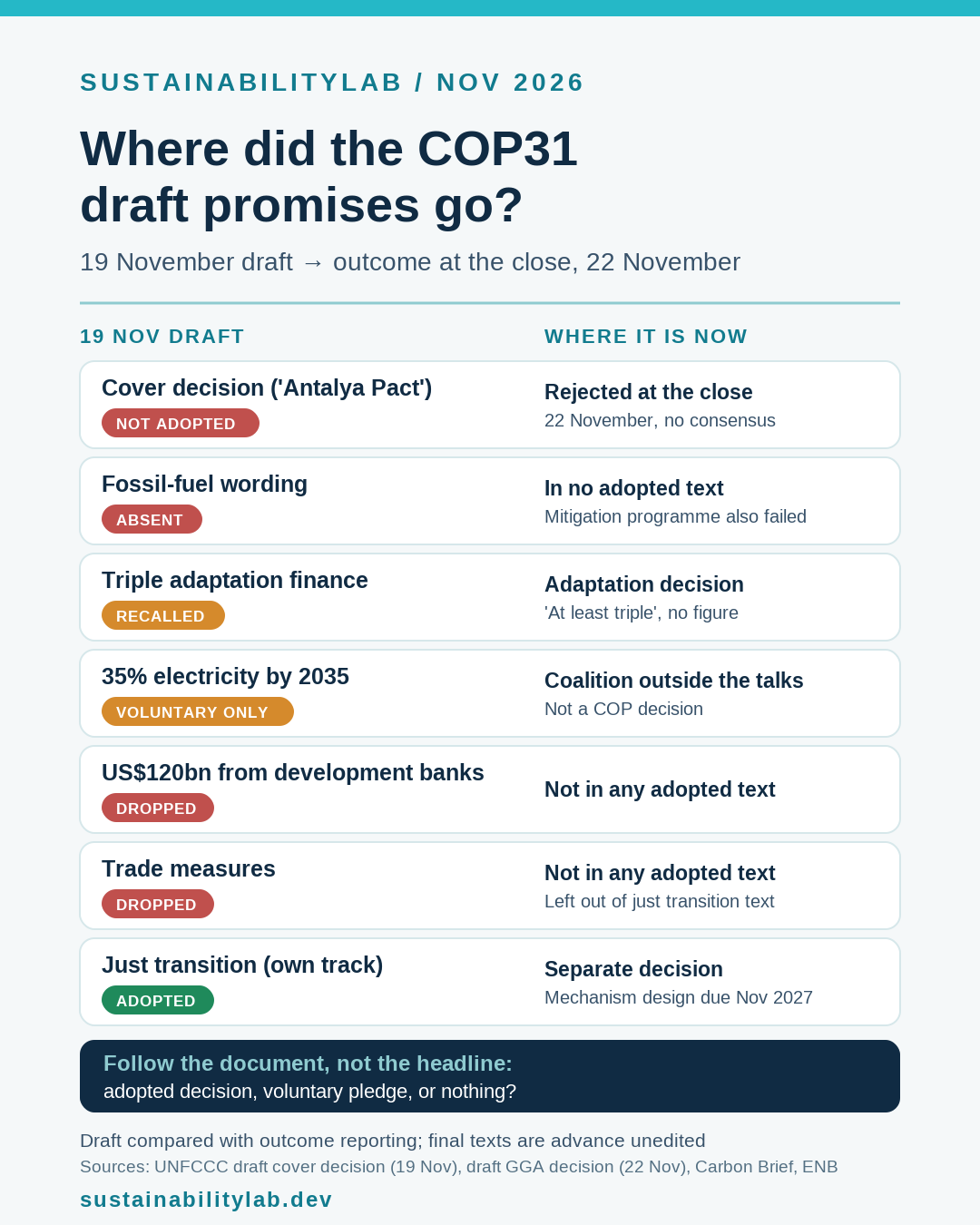
The tracker compares the official 19 November draft with outcome reporting. The final decision texts are advance unedited versions.
Correction to our 21 November article: we wrote that the 35% electricity goal "stayed". It stayed between the two drafts, but it did not reach any adopted text.
Why the cover decision fell
COP decisions need consensus. In the closing plenary, Panama, the Marshall Islands, Belize, Norway and Vanuatu rejected the final cover text, and the UK, the least developed countries, South Korea and Japan said there was no consensus. Carbon Brief counts at least 32 countries rejecting it. Their reasons: no reference to fossil fuels, numerical targets for carbon capture and storage, no response to overshooting 1.5°C, and no clear adaptation finance figure. The EU said it would not endorse a pact that "does not even mention fossil fuels". On the other side, Russia opposed any fossil-fuel wording. Source: Carbon Brief · Down To Earth
Where each draft item ended up
| 19 November draft | Outcome at the close | Where it sits now |
|---|---|---|
| Fossil fuels (already not named in the draft) | Absent | No adopted text. The mitigation work programme, which could have recalled the COP28 language, was not adopted |
| At least triple adaptation finance by 2035 | Recalled, with no figure or baseline | Adopted adaptation (Global Goal on Adaptation) decision |
| 35% electricity in final energy by 2035 | Not adopted | Voluntary coalition outside the negotiations |
| US$120 billion a year from development banks | Dropped | Not found in any adopted text |
| Carbon capture and storage figures | Dropped | A main reason for objections |
| Unilateral trade measures and dialogue | Dropped | Trade was also left out of the just transition decision |
| Response to 1.5°C overshoot | Dropped | Not in the adaptation decision |
| Launch of the second Global Stocktake | Proceeds | Its own process, running to 2028 |
Primary source: UNFCCC, revised draft cover decision, 19 November 2026 · UNFCCC, draft adaptation decision, 22 November 2026
On electrification, Carbon Brief reports that around 80 countries signed up to the 35% goal outside the negotiations; the COP31 President had cited around 30 a day earlier. Either way, it is now a voluntary pledge, not a COP decision.
What was adopted
Just transition. The work programme was extended by three years, with a review in November 2029. Parties agreed to set up the Just Transition Mechanism in phases: views are due by 15 March 2027, the design is to be developed at the June 2027 session, and adoption is planned for COP32 in Addis Ababa, Ethiopia, in November 2027. Carbon Brief reports that critical minerals appear in a COP decision for the first time. Source: The Climate Watch · Carbon Brief
Adaptation. A technical task force (six experts per UN regional group, plus three each from the least developed countries and small island states) will refine the methods behind the Belém adaptation indicators adopted at COP30. Countries can report on voluntary testing until 31 August 2027, and the task force ends in November 2027. The decision recalls the call to "at least triple adaptation finance by 2035", without a dollar figure. Primary source: UNFCCC, draft adaptation decision
Also adopted: the climate finance work programme, long-term finance, carbon market rules under Article 6 and Article 2.1(c) on aligning finance flows. Not adopted: the mitigation work programme (Saudi Arabia and Russia objected), response measures and Action for Climate Empowerment. These return to the Bonn session in June 2027. Source: ENB
One idea: follow the document, not the headline
Under consensus, one bundled text can fall while the separate agenda decisions stand. So "did COP31 succeed?" is the wrong question. The useful one is: which document carries this commitment now? There are three possible answers, each with different weight:
- An adopted decision: agreed by all parties, with mandates and deadlines (just transition, adaptation).
- A voluntary coalition: signed by some countries, with no collective mandate (35% electricity by 2035).
- Nothing: the item was dropped (US$120 billion from development banks, trade measures).
What it means for companies
COP decisions do not create company obligations, but they feed the policy assumptions in transition plans. Four checks:
- Transition plan assumptions: if a plan under ESRS E1 or IFRS S2 cites "35% electrification by 2035" or COP fossil-fuel language, label it correctly: a voluntary coalition, or the COP28 stocktake wording, not a COP31 decision.
- Just transition: the mechanism's design through 2027 may shape expectations on workforce, supplier and critical-minerals sourcing. Track the March 2027 submissions.
- Physical risk data: the national adaptation indicators are still being tested. Use them as context, not as company metrics.
- Trade exposure: no COP text limits unilateral climate trade measures, so plan for carbon border measures to continue (see the UK item below).
Educational takeaway: Before asking whether something was agreed, ask which document carries it: adopted decision, voluntary coalition or nothing.
Limitations: We read the 19 November draft and the 22 November draft adaptation decision ourselves. The final advance unedited texts, including the just transition decision, could not be opened during our check, so those details rely on Carbon Brief, ENB and The Climate Watch. Reports differ on the number of countries backing the 35% goal and on the status of the proposed Global Implementation Accelerator. We could not confirm the total number of decisions adopted.
Other updates this week
EU simplifies Taxonomy criteria · 26 November. The Commission adopted two delegated acts amending the climate and environmental criteria of the EU Taxonomy, with targeted simplifications to the "do no significant harm" tests. Parliament and Council have four months (extendable by two) to object but cannot amend. The new criteria apply from 1 January 2028; for financial year 2027 companies may still use the current ones. Stage: adopted by the Commission, not yet in force. Source: Linklaters, 27 November 2026
UK drafts CBAM exemption for EU, EEA and Swiss goods · 23 November. HMRC published draft law so that the UK carbon border adjustment, which starts on 1 January 2027, is not charged on goods originating in the EEA or Switzerland. It would apply retrospectively once enacted. It follows the conclusion of UK–EU emissions trading link talks on 20 November; the matching EU exemption for UK goods is expected from 2028 but needs an EU act. Stage: draft legislation. Primary source: HMRC · CBAM Guide
Energy efficiency improves, partly for the wrong reason · 23 November. The IEA's Energy Efficiency 2026 estimates that global primary energy intensity improves by nearly 3% in 2026, up from about 2% in 2025, with energy demand broadly flat while the economy grows about 3%. Part of the gain reflects demand cuts during the energy crisis rather than lasting efficiency, and it remains below the roughly 4% a year needed to double the rate by 2030. Companies should separate efficiency gains from lower output in their own intensity figures. Figures as reported; we could not re-check them on the IEA site. Source: IEA
Climate finance for food systems falls · 24 November. FAO reports that climate-related development finance for agrifood systems fell 10% in 2024, compared with 2% across all sectors. Food-producing sectors received 5% of the total, while food and agriculture account for 18% of climate finance needs, and 86% of national climate plans report climate impacts on agrifood systems. The 5% and 18% use different bases and are not directly comparable. Source: FAO, 24 November 2026
Drained peatlands keep warming the planet · 25 November. A Nature study reconstructing peatland drainage since 1800 finds that draining about 15% of the world's peatlands, around 0.5% of land, accounts for about 2.7% of human-caused warming, and that peatlands already drained could nearly double cumulative peatland warming by 2100. Relevant for palm oil, pulp and agricultural supply chains. Modelled estimate, peer-reviewed. Source: Yu et al., Nature
Record heat drained rivers and lakes · 26 November. A Science study of 150 river basins and more than a million lakes and reservoirs finds that in 2023–2024 river discharge fell about 5.7% and lake and reservoir storage about 9.5% below the 1991–2020 average, with the steepest drops in South America. It covers one two-year event. Relevant for water-intensive sites and physical risk baselines. Source: Zhang et al., Science
Tyre particles darken snow and ice · 27 November. A Nature Climate Change study estimates that tyre-wear particles on snow and ice cause a warming effect of about 17% of that of black carbon, with large uncertainty (0.015 ± 0.012 W/m²). A new climate angle on non-exhaust vehicle pollution. Source: Liu et al., Nature Climate Change
Food's biodiversity footprint decouples only in richer countries · 23 November. A Nature Food study of 158 countries from 1995 to 2020 finds that the global biodiversity footprint of food consumption grew, driven by demand in lower-income countries; decoupling from economic growth is weakest for ruminant meat, and trade shifts part of rich countries' footprint abroad. It covers land use only. Source: Zheng et al., Nature Food
Sources
- UNFCCC, COP31 revised draft cover decision, 19 November 2026 (unedited)
- UNFCCC, draft decision on the Global Goal on Adaptation, 22 November 2026
- UNFCCC, COP31 outcome summary
- Carbon Brief, COP31 key outcomes, 23 November 2026
- Earth Negotiations Bulletin, COP31 summary report
- Down To Earth, COP31 ends with no major deal, 22 November 2026
- The Climate Watch, Just Transition Mechanism timeline
- Linklaters on the EU Taxonomy delegated acts, 27 November 2026
- HMRC, draft legislation on CBAM exemption for EU, EEA and Swiss-origin goods, 23 November 2026
- CBAM Guide on the UK draft exemption, 24 November 2026
- IEA, Energy Efficiency 2026
- FAO, COP31: increased funding needed for agrifood systems, 24 November 2026
- Yu et al., An enduring climatic burden from past peatland drainage, Nature, 25 November 2026
- Zhang et al., Extreme global heat triggered unprecedented decline in surface freshwater, Science, 26 November 2026
- Liu et al., Tyre wear particles as important contributors to cryosphere darkening, Nature Climate Change, 27 November 2026
- Zheng et al., Biodiversity footprints of food consumption decouple from economic growth at high income levels, Nature Food, 23 November 2026