
Anyone reading “emissions are falling” in a climate headline this autumn should check which emissions are meant. On 10 November 2026, the Global Carbon Budget, produced by more than 140 scientists, projected that fossil CO₂ emissions will fall slightly in 2026 while total CO₂ emissions, including land use, keep rising. The full report is a preprint under review. Source: Global Carbon Budget, 10 November 2026
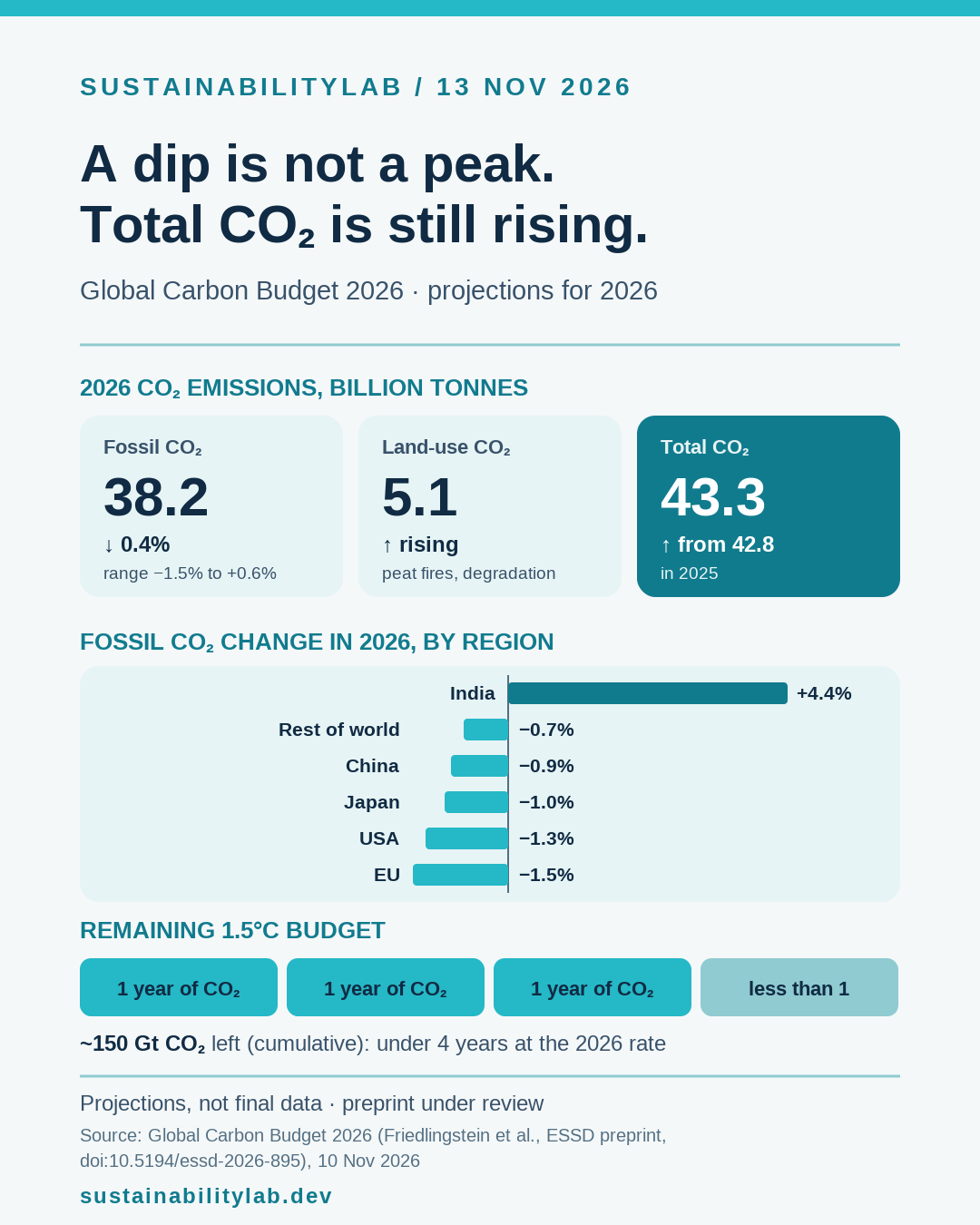
The visual shows Global Carbon Budget 2026 projections for 2026, not final measurements. The 150 billion tonne figure is a cumulative budget, not a calendar countdown.
What the Global Carbon Budget found
Fossil CO₂ emissions are projected at 38.2 billion tonnes in 2026, down 0.4%. The uncertainty range runs from a 1.5% fall to a 0.6% rise, so a small increase cannot be ruled out. Source: Friedlingstein et al., ESSD preprint
The fuels move in different directions. Oil emissions fall 1.9%, which the authors link mainly to a short-term energy shock from the Iran conflict. Gas falls 0.3%, while coal rises 0.6%. Regionally, China (−0.9%), the USA (−1.3%), the EU (−1.5%) and Japan (−1%) decline, while India rises 4.4%. Source: Global Carbon Budget
Land tells the opposite story. Emissions from land-use change are projected to rise to 5.1 billion tonnes, driven by peat fires and forest degradation in Southeast Asia linked to El Niño drying. That pushes total CO₂ emissions to 43.3 billion tonnes, up from 42.8 billion tonnes in 2025. Atmospheric CO₂ is projected to reach 427.7 ppm, 54% above pre-industrial levels. Source: University of Exeter, 10 November 2026
The remaining carbon budget for a 50% chance of limiting warming to 1.5°C is about 150 billion tonnes of CO₂, which the authors describe as less than four years of emissions at the current rate. Source: Global Carbon Budget
Why a dip is not a peak
A single falling year says little on its own. The authors are direct about this: a reduction “driven partly by geopolitical shocks is not a sustainable climate solution”, and a one-year drop “is not a peak unless it is driven by structural change”. Source: University of Exeter
There are structural signals too. Emissions avoided by solar and wind rose from 0.28 billion tonnes in 2010 to 4.1 billion tonnes in 2025, with 4.6 billion tonnes projected for 2026. Fifty-nine countries emitted less in 2025 than in 2019 while their economies grew. Over the past decade, total CO₂ emissions grew 0.3% a year, against 1.7% a year in the decade before. A companion analysis reported by the same team estimates that solar, wind and electric vehicles could offset 64–79% of the emissions growth from rising energy demand through 2028. That is a modelled estimate, not a forecast of decline. Source: University of Exeter
So the evidence supports slowing growth with a possible plateau, not a confirmed peak. Telling the two apart will take several years of data, especially with a strong El Niño expected to affect land emissions in the coming year.
What it means for companies
Companies writing transition plans under ESRS E1 or IFRS S2 face the same question in miniature: is a fall in our emissions structural or circumstantial? Three checks help:
- Separate drivers. Was a reduction caused by efficiency, electrification and clean supply, or by lower output, prices or a one-off disruption?
- Count land. For agri-food, forestry and forest-risk supply chains, land-use emissions can cancel out fossil gains, as they do globally this year.
- Use the budget as context, not a deadline. The 150 billion tonne figure is a global, cumulative budget. It explains why most 1.5°C pathways now involve overshoot, as covered in our Emissions Gap Report article; it is not a date by which any company must reach zero.
Educational takeaway: One year of falling fossil emissions is welcome but is not a peak. Only a sustained decline driven by structural change, with land emissions included, would show that.
Limitations: The Global Carbon Budget 2026 is a discussion preprint, not yet peer-reviewed, and its 2026 values are projections from partial-year data. We did not open the companion journal paper and report its finding only as described by the University of Exeter. We do not assess any country’s or company’s emissions or plan.
Other updates this week
Revised ESRS now in force · 10 November. Commission Delegated Regulation (EU) 2026/1563 entered into force on 10 November 2026 and applies to financial years starting on or after 1 January 2027. For financial years starting in 2026, companies can use the existing ESRS, the existing ESRS with reliefs, or the revised standards in full. It does not change CSRD scope. Primary source: EUR-Lex
EU drafts a sustainability assurance standard · 12 November. The Commission opened a targeted consultation, until 18 January 2027, on a draft limited-assurance standard for CSRD reporting, building on work by European audit oversight bodies. It is a draft for a future delegated act, not an adopted rule. Primary source: European Commission
UN launches Net-Zero Recognition Framework · 12 November. The voluntary framework shows non-state actors’ net-zero commitments and progress across five levels, from a public commitment to net zero achieved. Eight initiatives are eligible and 78 signatories opted in. It makes claims visible; it does not assure them. Primary source: UNFCCC
UK consults on forest-risk due diligence · 11 November. Defra proposes a legality-based due diligence framework for businesses using timber and forest-risk commodities in Great Britain. The consultation closes on 17 January 2027; no regulations have been made. Primary source: Defra
2026 among the four warmest years · 9 November. The WMO puts January–September 2026 at 1.47 ± 0.13°C above the 1850–1900 average, with record ocean heat and sea level. The figures are preliminary; the final report is due in March 2027. Primary source: WMO
EU emissions down 1.6% in 2025 · 9 November. The European Environment Agency puts net EU emissions 39% below 1990 and projects a 54% cut by 2030 with additional planned measures, close to the 55% target. Transport and buildings emissions rose. The 2025 figures are preliminary. Primary source: EEA
COP31 opens with pledges and progress tracking · 9–12 November. COP31 opened in Antalya on 9 November and runs to 20 November. A group of countries endorsed a voluntary goal of 35% electricity in final energy by 2035, and philanthropies pledged more than US$480 million for methane and other non-CO₂ gases. These are pledges, not delivered cuts. Primary source: UN News
Sources
- Global Carbon Budget news release, 10 November 2026
- Friedlingstein et al., Global Carbon Budget 2026, ESSD discussion preprint, 10 November 2026
- University of Exeter news release on the Global Carbon Budget, 10 November 2026
- EUR-Lex, Commission Delegated Regulation (EU) 2026/1563, September 2026
- European Commission targeted consultation on a limited assurance standard, 12 November 2026
- UNFCCC news on the Net-Zero Recognition Framework, 12 November 2026
- Defra consultation on forest-risk due diligence regulations, 11 November 2026
- WMO State of the Climate update for COP31, 9 November 2026
- European Environment Agency, Trends and Projections, 9 November 2026
- UN News on COP31 announcements, 12 November 2026