
Every government, company and investor that uses 1.5°C as a reference point now faces a different question. On 21 October 2026, the UN Environment Programme published the Emissions Gap Report 2026: The point of return. It concludes that warming will exceed 1.5°C, and sets out the pathway that would keep the overshoot as small and short as possible before bringing temperatures back down. Source: UNEP, 21 October 2026.
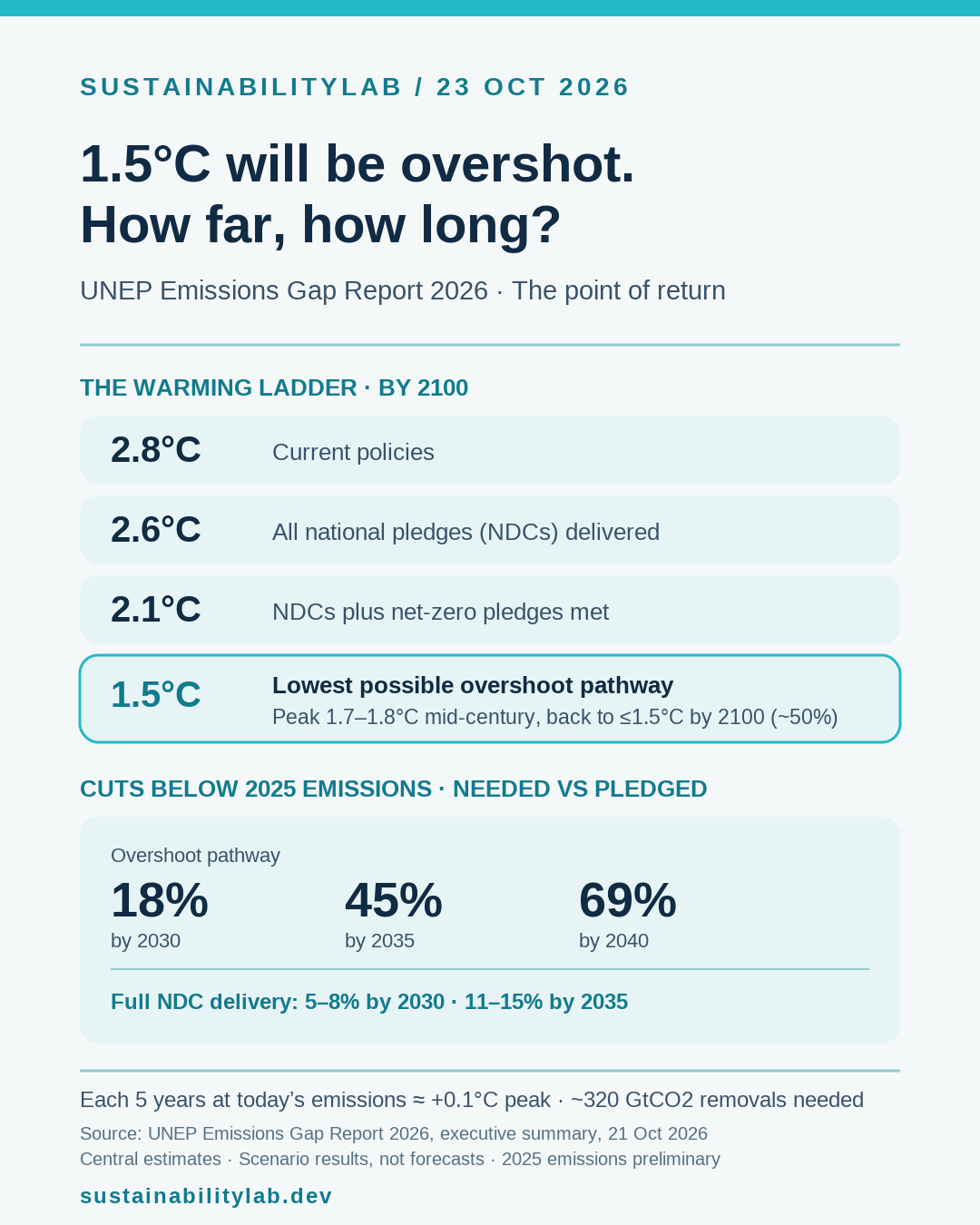
All figures come from the UNEP Emissions Gap Report 2026 executive summary. Temperatures are model-based central estimates; the visual does not show their uncertainty ranges.
What the report found
Global greenhouse gas emissions reached an estimated 58.4 GtCO2e in 2025, a slight fall of 0.1 Gt from 2024. UNEP is careful here: the uncertainty range is about ±5.5 Gt, so it says the direction of change cannot yet be confirmed. Source: UNEP Emissions Gap Report 2026, executive summary.
The report projects warming by 2100 of 2.8°C under current policies, 2.6°C if all nationally determined contributions (NDCs) are delivered, and 2.1°C if net-zero pledges are also met. These are estimates with a 66% likelihood. Source: UNEP, executive summary.
The new benchmark is a “lowest possible overshoot” pathway. Warming peaks at about 1.7–1.8°C around mid-century and returns to 1.5°C or below by 2100, with roughly a 50% chance. To follow it, emissions must fall 18% by 2030, 45% by 2035 and 69% by 2040 compared with 2025. That is an average cut of about 5.7% a year to 2035. Full delivery of the new NDCs would cut emissions by only 5–8% by 2030 and 11–15% by 2035. Source: UNEP, executive summary.
Why the overshoot framing matters
Overshoot changes how delay should be read. UNEP estimates that each five years of emissions at current levels adds about 200 GtCO2 and raises peak warming by about 0.1°C. A target that slips by five years is therefore not neutral; it has a temperature cost. Source: UNEP, executive summary.
Coming back down also depends on removals. The pathway needs about 320 GtCO2 of carbon dioxide removal and permanent storage this century. Removals are what make the return possible, not a substitute for cutting emissions now. Source: PBL Netherlands Environmental Assessment Agency, 21 October 2026.
Responsibility is concentrated. G20 members, excluding the African Union, account for 76% of global emissions, and their emissions rose 0.7% in 2025. Preliminary data show the largest national increase in the United States, about 133 MtCO2e, while the EU and India recorded decreases; data sets differ on India’s direction. Source: UNEP, executive summary.
What it means for transition plans
For companies, “1.5°C-aligned” is becoming shorthand for a pathway that overshoots and then returns. Transition plans prepared under ESRS E1 or IFRS S2, and targets validated against science-based methods, are easier to assess when they say which reference pathway they use, by when, and how much of the plan relies on removals rather than reductions.
Three questions help when reading a climate claim: Which scenario is the reference? What happens if the timetable slips by five years? How much depends on removals that do not yet exist at scale?
Educational takeaway: A pledge, a delivered policy and a 1.5°C pathway are three different numbers. The report shows the distance between them in degrees and in percentage cuts.
Limitations: This article is based on the report’s executive summary and UNEP and PBL announcements, not on its full modelling chapters. The 2025 emissions estimate is preliminary. Temperature outcomes are scenario results, not forecasts. We do not assess any company or country plan. UNEP’s report is an assessment; it creates no legal obligations.
Other updates this week
EU carbon market reserve kept, with a higher threshold · 20 October. Council and Parliament provisionally agreed the first stand-alone change to the ETS Market Stability Reserve: invalidation of allowances continues, but only above 700 million allowances instead of 400 million. The Commission had proposed halting invalidation. The deal still needs endorsement and formal adoption. Primary source: Council of the EU.
Two versions of packaging EPR relief · 20–21 October. Parliament voted to suspend the duty to appoint an authorised representative for extended producer responsibility for EU small and micro firms until 2035. A day later, Council’s mandate limited the suspension to producers placing under one tonne of packaging in another member state, until 1 January 2032. Both are negotiating positions. Primary source: Council of the EU; Parliament vote: HowTheyVote.
€3.4 billion for 77 net-zero projects · 19 October. The Commission selected Innovation Fund projects in 23 countries, including a first small modular reactor and a first direct air capture project. Its estimate of about 290 MtCO2e avoided over ten years depends on projects being built; grant agreements are due in early 2027. Primary source: European Commission.
Parliament backs a Critical Raw Materials Centre · 20 October. MEPs supported an EU agency with a €2 billion fund and a conditional power to restrict exports of scrap containing permanent magnets. This is Parliament’s position for negotiations with member states. Source: Eunews.
Canada finalises its taxonomy methodology · 20 October. The Taxonomy and Transition Planning Council published its final Methodology Report on green and transition categories and safeguards. Oil and gas abatement goes to further research, and sector criteria are due by the end of 2027. Primary source: Taxonomy and Transition Planning Council.
COP17 negotiations under way · 19 October. The UN Biodiversity Conference opened in Yerevan, with the first global review of the biodiversity framework and finance on the agenda. Talks run until 30 October; no decisions have been adopted yet. Primary source: CBD.
Sources
- UNEP story on the Emissions Gap Report 2026, 21 October 2026
- UNEP Emissions Gap Report 2026 executive summary, October 2026
- UNEP Emissions Gap Report 2026 publication page, October 2026
- PBL summary of the Emissions Gap Report 2026, 21 October 2026
- Council of the EU press release on the ETS Market Stability Reserve, 21 October 2026
- Council of the EU mandate on EPR authorised representatives, 21 October 2026
- HowTheyVote record of the Parliament EPR vote, 20 October 2026
- European Commission on Innovation Fund selection, 19 October 2026
- Eunews on the Critical Raw Materials Act vote, 20 October 2026
- Taxonomy and Transition Planning Council release, 20 October 2026
- CBD COP17 announcements, October 2026