
Governments, energy companies and anyone writing a climate transition plan now have a shared reference for what “transitioning away from fossil fuels” could look like in practice. On 3 November 2026, Brazil’s COP30 Presidency published a global roadmap to implement that call from the 2023 Global Stocktake, a week before COP31 opens in Antalya. It is a voluntary Presidency contribution: governments have not negotiated or agreed it. Source: COP30 Presidency, 3 November 2026.
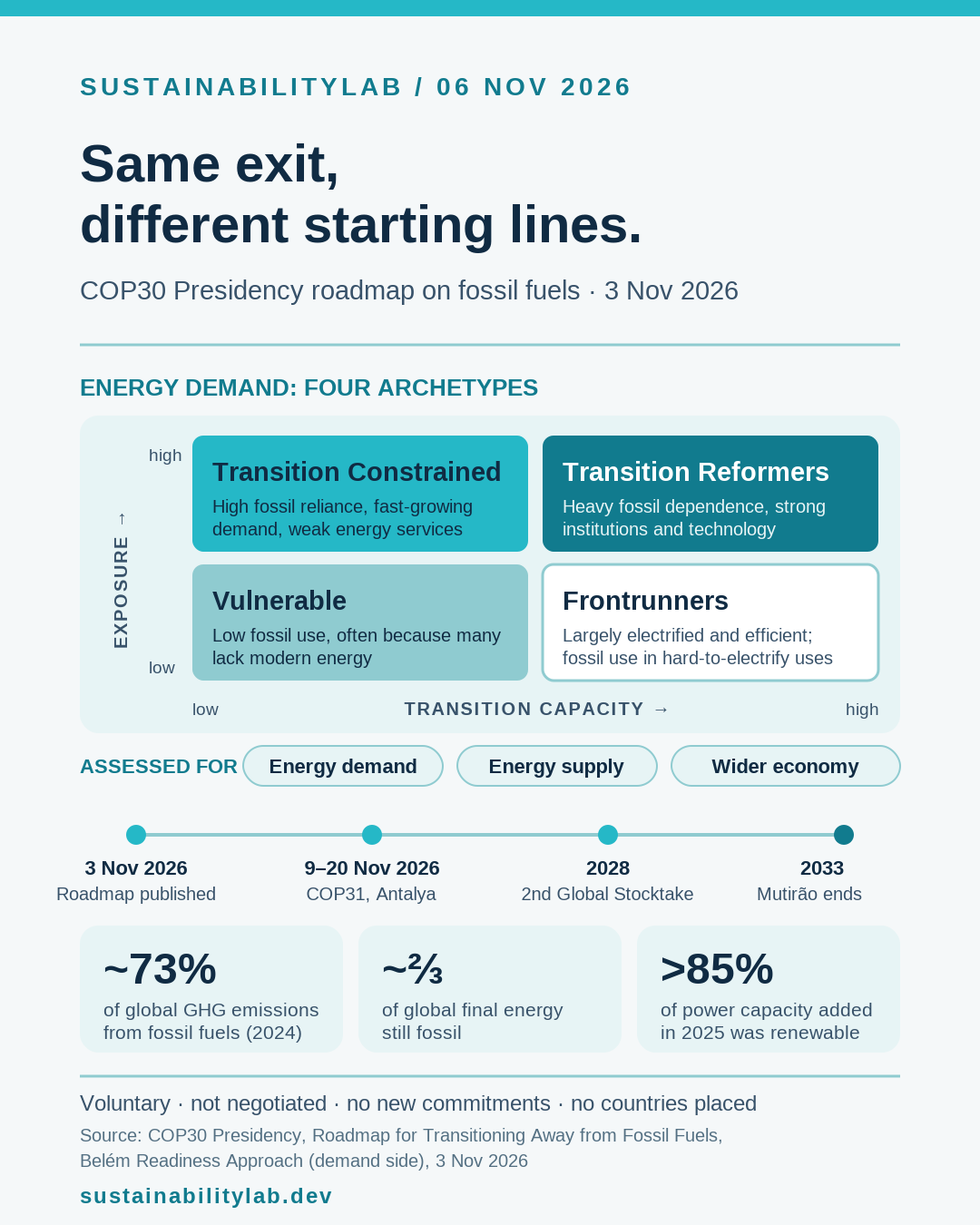
The matrix shows the four demand-side archetypes defined in the roadmap; it does not place any country. All figures come from the roadmap. The roadmap is voluntary and creates no new commitments.
What the roadmap proposes
The roadmap’s starting point is that the transition is “urgent, inevitable and yet possible”. Source: COP30 Presidency, 3 November 2026. The document states plainly that it “creates no new commitments and is not a negotiated outcome”. Source: COP30 Presidency Roadmap.
Its main tool is the Belém Readiness Approach. Each country is assessed on two things: exposure, “the scale and complexity of the transformation required”, and transition capacity, “the capabilities and enabling conditions available to implement that transformation”. This is done separately for energy demand, energy supply and the wider economy. On the supply side, exposure covers fossil fuels in the supply mix, dependence on imports or exports, and reserve lock-in. Source: COP30 Presidency Roadmap.
For energy demand, the combination gives four archetypes:
- Transition Constrained countries face high fossil reliance and fast-growing demand, with weak electricity services and institutions.
- Transition Reformers are heavily dependent on fossil fuels but have strong institutions and technology.
- Vulnerable countries use little fossil energy, often because many people lack modern energy at all.
- Frontrunners are largely electrified and efficient, with fossil use concentrated in hard-to-electrify activities.
Every country gets five foundational levers: long-term demand planning, institutional coordination, access to modern energy, digital systems and demand-side management, and electrification with efficiency. Archetype-specific levers come on top. The roadmap then makes three proposals: start now at national, subnational and sector level; run a collective agenda, the “TAFF Mutirão”, through 2033; and keep the dialogue going into the second Global Stocktake in 2028. Source: COP30 Presidency, 3 November 2026.
A companion roadmap on forests aims to halt and reverse deforestation by 2030 and says forest finance must rise from US$84.5 billion in 2023 to more than US$300 billion a year. Source: COP30 Presidency.
Why readiness rather than deadlines matters
The 2023 Global Stocktake asked countries to transition away from fossil fuels but did not say how fast each should move. The roadmap answers with a diagnosis, not a timetable. That makes it easier for governments to accept and harder to hold anyone to. Fossil fuels still account for about 73% of global greenhouse gas emissions (57.7 GtCO₂e in 2024) and around two-thirds of global final energy consumption. Yet renewables made up more than 85% of power capacity added in 2025, and clean energy investment now exceeds investment in fossil fuel supply. Source: COP30 Presidency Roadmap.
Critics see a risk in the sequencing. Oil Change International warns against any suggestion that supply-side action could wait until the 2030s. Source: Oil Change International. At COP31, some countries may push to reference the roadmap in the summit’s cover decision, while fossil fuel producers oppose this. Source: Climate Home News, 5 November 2026.
What it means for companies
The roadmap does not regulate companies. Its framing still helps anyone preparing a transition plan under ESRS E1 or IFRS S2. The split into demand, supply and economy mirrors a company’s own exposure: energy use in its operations, fossil inputs in its supply chain, and revenue tied to fossil fuels.
Three questions help: Which archetype best describes the countries where we operate and source from? Does our transition plan assume grid electrification or efficiency rules that those countries may not deliver on time? Which of our assets or suppliers depend on fossil supply that the roadmap expects to decline?
Educational takeaway: A roadmap can describe how ready each country is without telling anyone how fast to move. That makes it a useful diagnostic, but not an obligation.
Limitations: The roadmap is a voluntary, non-negotiated Presidency document with no legal force. We read its framework and context sections; the text we could access did not include the detailed stages of the TAFF Mutirão, so we do not describe them. We do not place any country in an archetype or assess any national plan.
Other updates this week
Adaptation finance far below need · 4 November. UNEP’s Adaptation Gap Report 2026 estimates developing countries need about US$305 billion a year by 2035, against US$28.2–31.7 billion of international public adaptation finance in 2024. Even tripled, flows would cover only 20–29% of needs. Needs largely exclude the private sector. Primary source: UNEP Copenhagen Climate Centre.
COP17 closes with the Yerevan Pathway · 31 October. The first global review of the Kunming-Montreal framework finds the world “off track to meet the Framework’s 23 targets by 2030”. Countries did not widen the list of donor countries, and the form of post-2030 finance was deferred to COP18 in 2028. Primary source: CBD.
Electrification goal needs a fourfold speed-up · 2 November. Climate Action Tracker finds that raising electricity from almost 24% of final energy in 2023 to 35% by 2035 needs electrification to speed up almost four times; current policies reach 28%. Grids, storage and flexibility must expand alongside demand. Primary source: Climate Action Tracker.
Seagrass carbon burial revised down · 4 November. A synthesis of 332 sediment cores estimates an area-weighted burial rate of 33 ± 9 g of organic carbon per square metre a year, or 6–15 Tg C a year globally, about a quarter of earlier benchmarks. It remains within the IPCC default range. Primary source: Nature Communications.
Land change weakens drought insurance in Africa · 3 November. About 25% of Africa’s land shows significant long-term vegetation change, only 7% mainly linked to rainfall. Around 20% of index-insurance units studied in the Horn of Africa are affected. This is an early-access version. Primary source: Humanities and Social Sciences Communications.
GRI climate and energy standards apply from 2027 · 5 November. GRI reminded reporters that GRI 102: Climate Change and GRI 103: Energy take effect from 1 January 2027. They are voluntary unless another rule requires GRI. Primary source: GRI.
Sources
- COP30 Presidency news release on the fossil fuel and deforestation roadmaps, 3 November 2026
- COP30 Presidency Roadmap for Transitioning Away from Fossil Fuels, November 2026 (PDF)
- Oil Change International statement on the roadmap, November 2026
- Climate Home News COP31 briefing, 5 November 2026
- UNEP Copenhagen Climate Centre on the Adaptation Gap Report 2026, 4 November 2026
- CBD press release on the close of COP17, 31 October 2026
- Climate Action Tracker press release on electrification, 2 November 2026
- Nature Communications paper on seagrass carbon burial, 4 November 2026
- Humanities and Social Sciences Communications paper on land degradation and drought insurance, 3 November 2026
- GRI news on climate disclosure at COP31, 5 November 2026