
New guidance and research show why a restoration project must be assessed in its wider landscape.
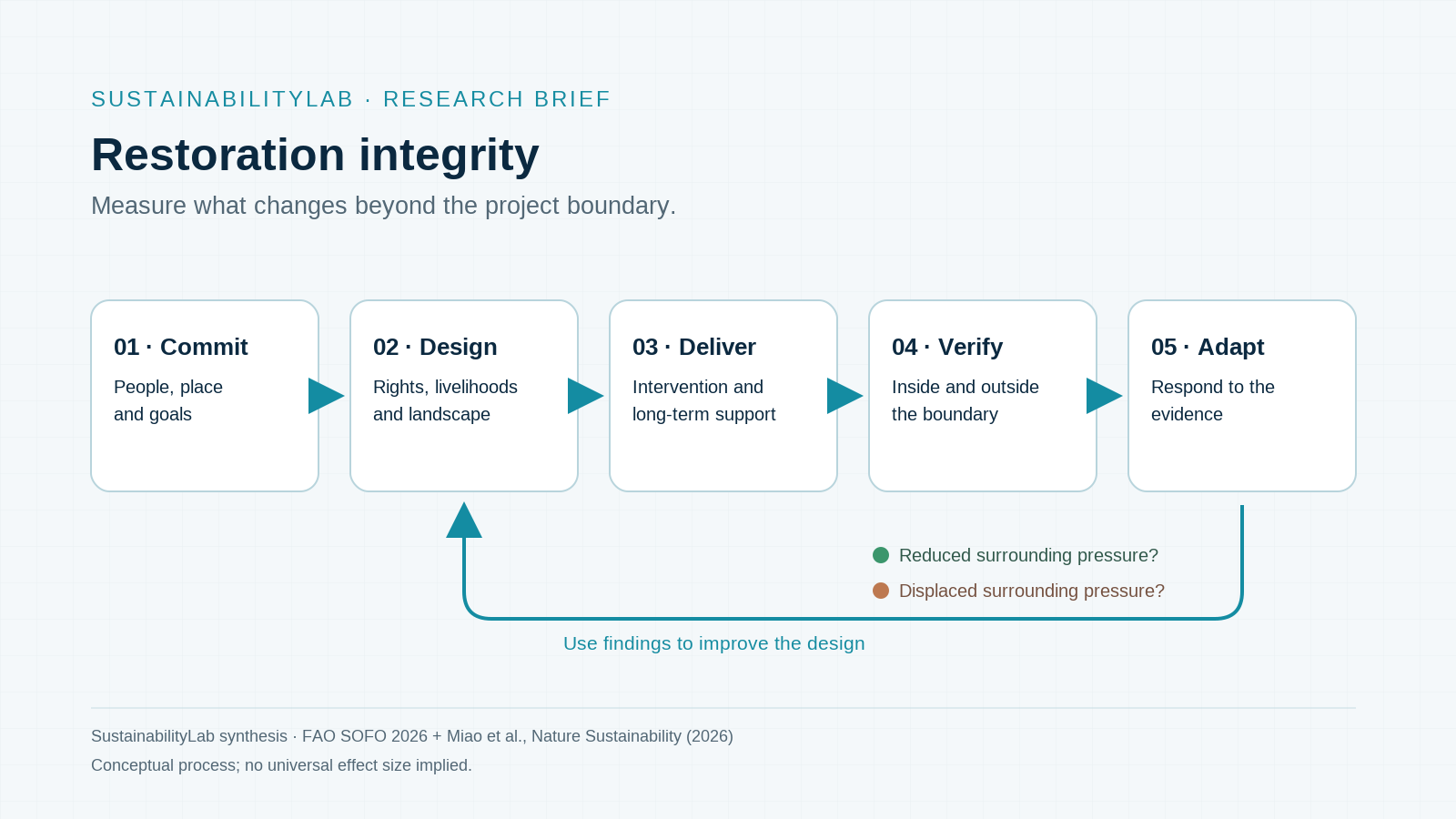
The SustainabilityLab restoration integrity cycle combines FAO's four pathways with a study's lesson about measuring outcomes beyond project boundaries. Positive and negative spillovers are possibilities to investigate, not outcomes guaranteed by a method.
Governments and organizations often describe forest restoration through hectares pledged, trees planted or projects launched. These figures tell us something about ambition and activity. They cannot, on their own, tell us whether an ecosystem is recovering or whether pressure has moved somewhere else.
The UN Food and Agriculture Organization's State of the World's Forests 2026 calls for restoration built around people and rights, landscape-scale planning, suitable finance, and coherent institutions. A new study of restoration in sub-Saharan Africa adds a practical measurement question: what happened outside the mapped project?
Restoration takes place in a landscape
FAO estimates that forests cover 4.14 billion hectares globally and store around 714 gigatonnes of carbon. It also reports that 489 million hectares of forest were lost through deforestation between 1990 and 2025, while more than 460 million hectares of forest are degraded.
The scale of the challenge makes restoration necessary. It also makes the quality of restoration important.
FAO identifies four mutually reinforcing pathways:
- Put people, their rights and their knowledge at the centre.
- Plan and implement across the landscape.
- Align finance and business models with long-term outcomes.
- Establish coherent policies, laws and institutions.
A restored site remains connected to nearby farms, forests, markets and communities. Changing land use inside a project can change decisions outside it. Assessment therefore needs to look beyond the project map.
What happens beyond the boundary?
A study published in Nature Sustainability examined restoration projects across sub-Saharan Africa and investigated changes in tree loss both within restoration areas and in surrounding landscapes.
The researchers describe positive leakage when an intervention is associated with reduced tree loss beyond its boundary, and negative leakage when pressure is displaced or tree loss increases nearby. In the analysed data, natural regeneration and active restoration were associated with lower tree loss inside and around projects. Some agroforestry contexts showed increased tree loss.
These findings do not establish that one restoration method is always beneficial and another is always harmful. Effects differed by context, and tree loss captures only part of the ecological and social picture. The more useful lesson is that a project-level result can differ from the wider landscape result.
A practical restoration integrity cycle
SustainabilityLab interprets the combined evidence as five questions to revisit throughout a project:
- Commit: Which ecosystem, people and outcomes does the project address?
- Design: Does the intervention fit local land use, rights and livelihoods?
- Deliver: Are participation, finance and benefit sharing credible over time?
- Verify: What changes inside the site and in the surrounding landscape?
- Adapt: What should change if monitoring reveals displaced pressure or unintended harm?
Hectares and tree counts can document implementation. Depending on the project, a stronger assessment may also examine biodiversity, carbon permanence, water, soil, tenure, livelihoods, fire risk and land-use changes around the site.
Why this matters for sustainability claims
A restoration pledge is a statement of ambition. A mapped intervention shows where work took place. Neither alone proves ecological recovery.
This distinction matters for public programmes, corporate nature strategies and carbon projects. If a site becomes greener while resource use or land conversion shifts elsewhere, reporting only the site may overstate the overall benefit. Conversely, beneficial effects may extend beyond the original boundary and be missed by site-only measurement.
Educational takeaway: Ask whether environmental pressure declined across the landscape, and whether benefits can endure for the people who live and work there.
Limits of the evidence
The study examines a geographically specific and unevenly documented set of projects. Its principal outcome is tree loss, not a complete measure of biodiversity, carbon or livelihoods. Its spatial analysis of nearby effects is also limited to a ten-kilometre buffer. FAO's global estimates and pathways do not guarantee the same results for any individual project.
The evidence supports better design and monitoring questions. It does not provide a universal ranking of restoration methods.
Other updates this week
Ocean monitoring: the tenth Copernicus report
30 September 2026. The tenth Copernicus Ocean State Report brings together monitoring of ocean change, including regional marine heatwaves, polar changes and coastal risks. Its research on the Mediterranean and Black Seas illustrates why surface and subsurface conditions both matter; a regional extreme should not be presented as a uniform global condition. Explore the report and its chapters.
Cities: stronger evidence for individual actions than system-wide change
29 September 2026. A Nature Cities overview assessed 60 systematic reviews and synthesized findings from 49 after confidence assessment. It found health benefits particularly through active transport and improved housing, while finding no published evidence in its review of implemented city-wide, cross-sector transformation delivering the necessary climate and health outcomes. That evidence gap does not show such action is ineffective. Read the open-access study.
EU environmental assessments: a Council negotiating position
30 September 2026. The Council agreed a position on faster environmental-assessment procedures, including digitalisation and single points of contact. It also called for exploration of a targeted response to possible disproportionate packaging EPR burdens on small producers. This is a negotiating mandate, not final enacted legislation; negotiations with Parliament are still ahead. Read the Council announcement.
Trade and climate: making carbon methods work together
28–29 September 2026. WTO members discussed practical interoperability problems for trade-related climate measures, using steel and emissions measurement, reporting and verification as examples. This was discussion and voluntary information sharing, not a binding WTO carbon-accounting rule. Read the WTO meeting summary.
Cultural heritage enters climate adaptation planning
29 September 2026. The European Commission announced a ten-year, €215 million partnership involving 90 partners from 30 countries to strengthen cultural heritage against climate and environmental change. This marks a research and funding commitment; it is not evidence that resilience outcomes have already been achieved. Read the Commission announcement.