
A bank or investor preparing science-based climate targets has more than one route through SBTi. On 8 October 2026, SBTi confirmed that financial institutions may continue using its Financial Institutions Near-Term Criteria and that both this route and its Financial Institutions Net-Zero Standard will remain available without a specified end date. Earlier, SBTi had said it would consider the future of the Near-Term Criteria in 2027. Source: SBTi, 8 October 2026.
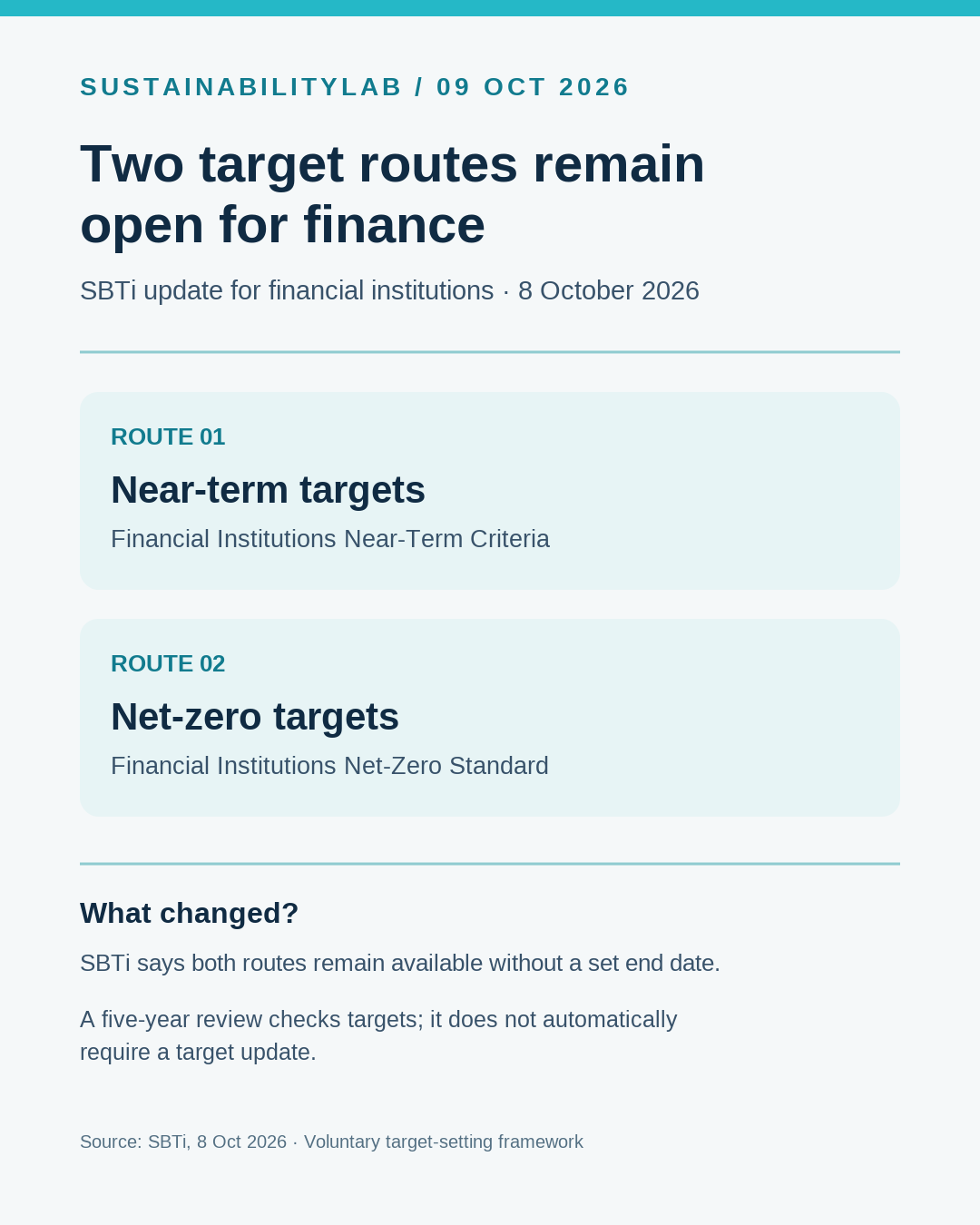
SBTi’s 8 October update keeps both routes open. Its five-year review does not automatically require a target update.
What the decision changes
The announcement gives institutions continuity when planning a target cycle. It does not say that near-term and net-zero targets are equivalent promises. An institution still needs to choose the relevant SBTi framework and meet its applicable criteria. SBTi also updated its Mandatory Five-Year Review Guidance to clarify finance-sector review timelines. Source: SBTi.
A five-year review is a check, not an automatic instruction to rewrite a target. SBTi says institutions assess their targets against the applicable requirements and determine whether an update is needed; targets that still meet those criteria need not be updated solely because a review occurred. Source: SBTi.
Why this matters
For a financial institution, the practical task is to record which framework and version it uses, the target cycle, and the evidence needed at review. For someone reading its sustainability report, the useful questions are different: What target was validated? What activities does it cover? What progress has the institution actually reported? Target validation describes the target’s assessment under a voluntary framework; it does not by itself demonstrate real-world emissions reductions.
SBTi also announced updated finance resources, including changes to its target-setting tool. Two sector calculations are temporarily paused pending final sector standards, so institutions should check the current tool and implementation list before relying on an earlier calculation workflow. Source: SBTi.
Educational takeaway: Read a climate target as a specific commitment with a framework, scope and review cycle. Read reported emissions and implementation evidence separately.
Limitations: This article summarizes SBTi’s announcement; it does not assess any institution’s target or performance. SBTi is a voluntary initiative, and the announcement does not create a new reporting law. Source: SBTi.
Other updates this week
Great Green Wall programme announced · 6 October. UNEP announced a GEF-backed US$78 million programme spanning nine countries, with goals to restore more than 270,000 hectares and improve livelihoods for five million people. The figures describe planned reach; delivery and outcomes will need later verification. Primary source: UNEP.
Cooling starts with design · 6 October. UNEP outlined five ways buildings and cities can reduce dependence on conventional air conditioning, including shade, reflective surfaces and ventilation. Performance varies with climate, building design and how measures are combined. Primary source: UNEP.