
Companies and financial institutions are now part of the first global review of the Kunming-Montreal Global Biodiversity Framework. On 15 October 2026, the Convention on Biological Diversity launched The State of Biodiversity Action, its first global assessment of progress towards the framework’s 23 targets for 2030. It found that fewer than half of the national targets assessed by Parties are on track, and that targets on business, consumption, harmful incentives and finance are among the furthest behind. Source: CBD Secretariat, 15 October 2026.
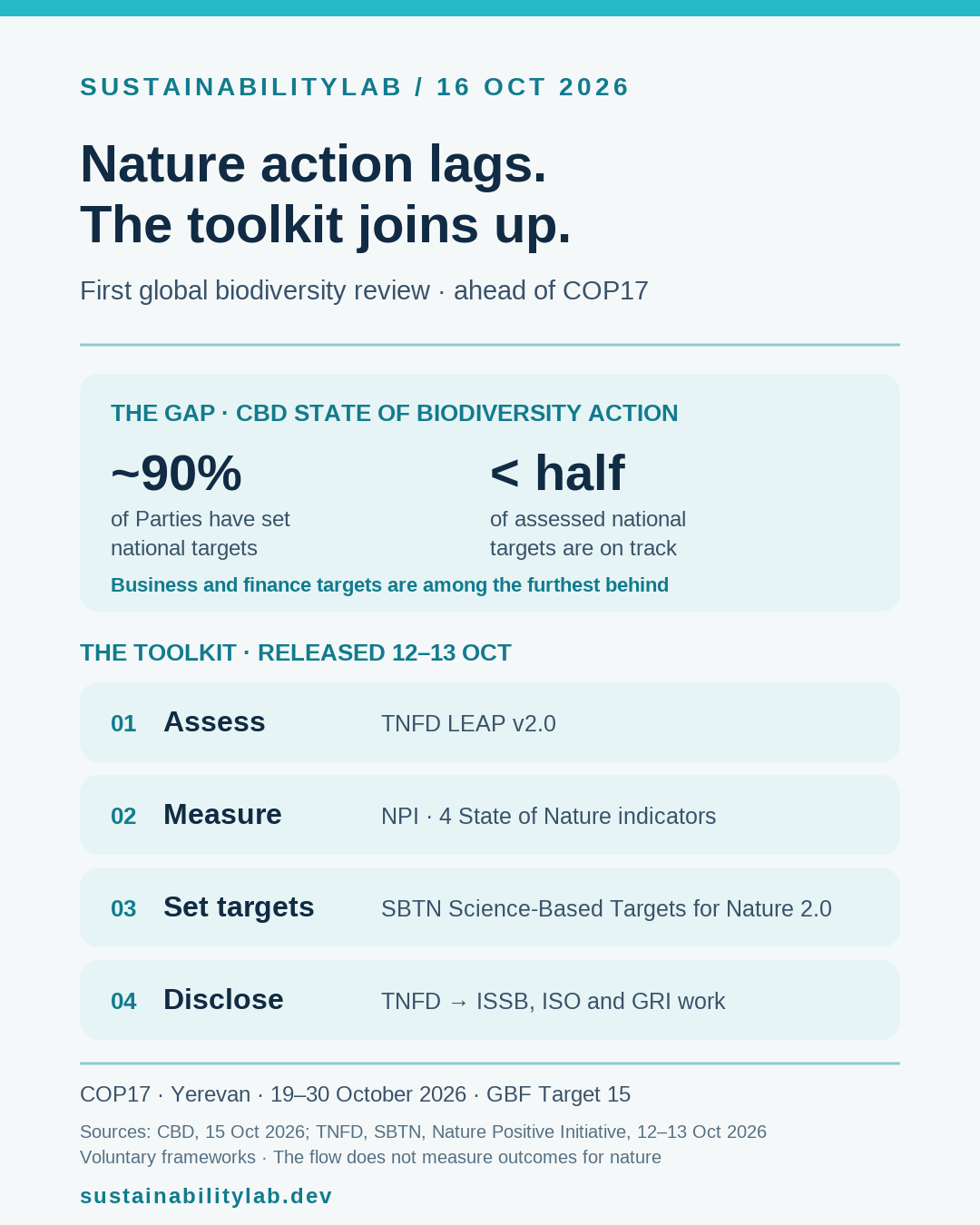
The figures come from CBD’s 15 October press release. The flow shows how the voluntary frameworks are designed to connect; it does not measure outcomes for nature.
What the global review found
The report draws on national targets, strategies and reports from the Convention’s 196 Parties. Nearly 90% of Parties have set national biodiversity targets, close to 60% have national biodiversity strategies and action plans, and over 70% have submitted national reports. Businesses, subnational governments, Indigenous peoples, local communities and civil society have registered about 5,000 commitments. Source: CBD Secretariat.
Ambition on paper is not the same as progress. Fewer than half of the national targets assessed are on track. National pledges fall “well short” of conserving 30% of land and sea by 2030, and far fewer countries have committed to reducing harmful subsidies than to creating positive incentives. The report links the slowest areas to targets that need action beyond environment ministries, including business and finance. Source: CBD Secretariat.
A day later, leaders meeting in Yerevan adopted the Yerevan Declaration, which acknowledges that collective progress is insufficient and calls for more public and private finance. Negotiations at COP17 run from 19 to 30 October. Source: Armenpress, 16 October 2026.
The toolkit companies can use
The week before the review, three voluntary initiatives released guidance designed to be used together. Source: TNFD, SBTN and Nature Positive Initiative, 13 October 2026.
- Assess: TNFD’s LEAP v2.0 is the first upgrade of its assessment approach since 2023. It adds state-of-nature measurement across land, freshwater and ocean, risk and opportunity assessment, assessments of financial institutions’ portfolios, and nature in transition planning. Source: TNFD.
- Measure: The Nature Positive Initiative’s State of Nature metrics set out four core indicators: ecosystem extent, ecosystem condition, species extinction risk and species populations. They were piloted by 29 companies at more than 50 sites in 23 countries. Source: TNFD, SBTN and NPI.
- Set targets and act: SBTN’s Science-Based Targets for Nature 2.0 adds routes for companies with imperfect data, including supplier-engagement targets and stepwise validation, extends freshwater methods to pesticide impacts, and adds a step on moving from targets to action. Independent validation remains central. Source: SBTN, 12 October 2026.
The joint release links this work to Target 15 of the global framework, which asks governments to encourage and enable large companies and financial institutions to assess and disclose their nature-related risks, dependencies and impacts. Source: TNFD, SBTN and NPI.
Why this matters
The review and the toolkit point to the same practical gap: many organisations can now describe their exposure to nature, but fewer can show targets and measured change. A company preparing ESRS E4 or a TNFD-aligned disclosure can reuse one location-based dataset for assessment, targets and reporting, rather than building separate exercises for each framework.
For readers of a sustainability report, the useful questions are: Where are the sites and supply-chain locations? Which state-of-nature indicators are used? Is there a validated target? What change has been measured?
Educational takeaway: Read nature claims in stages. An assessment, a target and a measured improvement in nature are three different pieces of evidence.
Limitations: This article is based on CBD’s press release, not the full report, and does not assess any company’s performance. TNFD, SBTN and the Nature Positive Initiative are voluntary initiatives; their guidance does not create legal obligations. COP17 outcomes are still under negotiation.
Other updates this week
IPCC session suspended without AR7 timeline · 16 October. The IPCC’s 65th session in Addis Ababa was suspended without agreement on whether its Working Group reports will arrive in 2028 or 2029. The budget also remains unresolved; this summary relies on non-IPCC sources. Primary source: Climate Action Network.
GRI financial-sector standards approved · 9 October. GRI’s banking, capital markets and insurance sector standards cover impacts linked to financing and underwriting. They apply to reports published from 1 January 2029 and are voluntary. Primary source: GRI.
Cookstoves enter the Paris crediting mechanism · 9 October. The Article 6.4 Supervisory Body approved two household cooking methodologies and a first tool for assessing reversal risk. The tool is expected to change as evidence improves. Primary source: UNFCCC.
EU positions for COP31 and COP17 · 12 October. Environment ministers approved conclusions for both summits and debated the review of the EU emissions trading system. These are negotiating positions; the ETS review remains a proposal. Primary source: Council of the EU.
ESMA on impact and transition claims · 12 October. ESMA published two thematic notes with do’s and don’ts for funds, bonds and benchmarks, including not presenting portfolio decarbonisation as real-economy emissions cuts. The notes create no new obligations. Primary source: ESMA.
Methane import rules may be delayed · 14 October. The European Commission proposed postponing several Methane Regulation requirements for importers and producers by one year. The proposal still needs agreement from Parliament and Council. Primary source: Brussels Times.
Western Indian Ocean work programme · 9 October. The Nairobi Convention’s COP12 adopted 15 decisions on marine spatial planning, plastic pollution, mangroves, seagrasses, coral reefs and blue finance. Decisions set a work programme; ecological outcomes will need later evidence. Primary source: UNEP.
Sources
- CBD Secretariat press release on The State of Biodiversity Action, 15 October 2026
- Armenpress on the Yerevan Declaration, 16 October 2026
- TNFD, SBTN and Nature Positive Initiative joint release, 13 October 2026
- TNFD LEAP v2.0 guidance, October 2026
- SBTN announcement of Science-Based Targets for Nature 2.0, 12 October 2026
- Climate Action Network statement on IPCC-65, 16 October 2026
- GRI standards for banking, capital markets and insurance, October 2026
- UNFCCC news on clean cooking methodologies, 9 October 2026
- Council of the EU Environment Council meeting page, 12 October 2026
- ESMA thematic notes on impact and transition claims, 12 October 2026
- Brussels Times on the Methane Regulation proposal, 14 October 2026
- UNEP press release on Nairobi Convention COP12, 9 October 2026