Europe’s New SME Sustainability Standard Could Change Scope 3 Data Requests
A smaller supplier can receive sustainability questionnaires from customers, banks and investors—all asking similar questions in different formats.
One customer wants greenhouse-gas data. Another requests water and workforce indicators. A bank asks about climate risks and transition plans. Each request may be reasonable on its own, but the combined burden can become substantial.
The European Union has now published a voluntary reporting standard intended to make this information flow more consistent.
The Voluntary Sustainability Reporting Standard for Undertakings Protected by the Value-Chain Cap appeared in the Official Journal of the European Union on 21 September 2026. It is designed for undertakings that do not exceed an average of 1,000 employees and are not themselves subject to mandatory sustainability reporting.
The standard is voluntary. It does not turn smaller companies into CSRD reporters.
Its more interesting role is connective: it gives smaller businesses, banks, investors and larger corporate customers a shared structure for exchanging sustainability information.
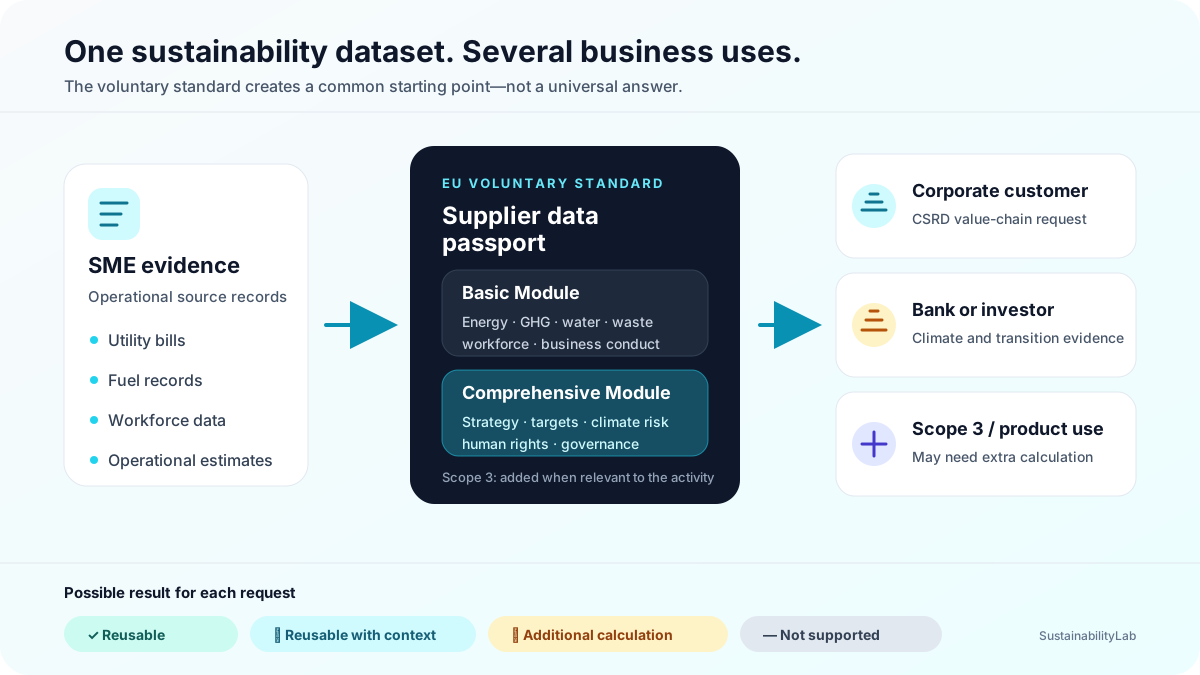
The voluntary standard can organize a common evidence base for several users. It does not guarantee that every request is answered without extra context or calculation.
What the standard actually contains
The standard has two modules.
The Basic Module contains general information and eleven disclosure areas covering:
- sustainability practices and policies;
- energy and greenhouse-gas emissions;
- pollution;
- biodiversity;
- water;
- circularity and waste;
- workforce characteristics;
- health and safety;
- remuneration, collective bargaining and training; and
- corruption and bribery.
The Comprehensive Module adds information likely to be requested by banks, investors and corporate customers, including business strategy, climate targets, climate risks, human-rights processes and selected governance information.
A company must complete the Basic Module before it can claim use of the Comprehensive Module.
The standard is also proportionate. Some datapoints are conditional, some are voluntary, and several Basic Module metrics are voluntary for businesses with ten employees or fewer.
These features are described in the interactive EFRAG standard.
The greenhouse-gas core
Basic disclosure B3 asks an undertaking to report estimated absolute gross greenhouse-gas emissions for:
- Scope 1: emissions from owned or controlled sources; and
- location-based Scope 2: emissions associated with purchased electricity, heat, steam or cooling.
The calculations are to consider the GHG Protocol Corporate Accounting and Reporting Standard.
Scope 3 is treated differently.
The standard does not make Scope 3 quantification a general requirement for every participating company. Instead, it says Scope 3 disclosure may be appropriate depending on the company’s activities and the relevance of value-chain impacts.
It specifically identifies manufacturing, agrifood, real-estate construction and packaging as activities likely to have significant Scope 3 categories.
That distinction is important. The standard creates a common starting point without pretending that every small company has the same value chain, data capacity or material emissions sources.
Why larger companies should pay attention
EFRAG describes the standard as part of the EU’s “value-chain cap.”
Its objective includes helping smaller undertakings answer information requests from companies subject to mandatory sustainability reporting. It is also intended to respond to the information needs of banks and investors.
This could make the standard a reusable sustainability-data passport.
A supplier might prepare one structured dataset and use it when responding to several customers or finance providers. Larger companies could design supplier questionnaires around the common disclosures instead of inventing an entirely separate format.
That is the intended direction. It is not yet evidence that every customer or bank will accept the same report without supplementary questions.
Sector-specific information may still be necessary. So may product-level emissions, customer-specific boundaries, primary activity data and evidence supporting estimates.
From corporate reporting to the SDGs
The standard covers environmental, social and governance issues that overlap with several Sustainable Development Goals.
Energy and greenhouse-gas information may inform discussion of SDGs 7 and 13. Water data relate to SDG 6. Workforce and safety information can support analysis connected with SDG 8. Materials, circularity and waste are relevant to SDG 12.
But these are thematic relationships—not proof of SDG performance.
Reporting energy use does not demonstrate progress toward affordable clean energy. Reporting water consumption does not establish improved basin-level water outcomes. A Scope 1 inventory does not, by itself, show that emissions are falling.
The standard structures company information. The SDGs describe much broader social, economic and environmental outcomes.
Any mapping between them should distinguish:
- a disclosure about an activity or condition;
- evidence of a change in company performance;
- evidence that the change contributed to a societal outcome.
Collapsing these three levels would overstate what reporting can establish.
SustainabilityLab interpretation
The most promising feature of the new standard is not the production of another sustainability report.
It is the possibility of data reuse.
A reporting framework creates value when information can move reliably between the organizations that need it. For Scope 3 accounting, that means data should be understandable, bounded consistently and supported by enough evidence to be used in a customer’s emissions inventory.
A common template can reduce duplicated requests. It cannot automatically solve weak estimates, incompatible boundaries or missing supplier activity data.
The quality of the exchange therefore depends on four questions:
- Is the requested datapoint actually covered by the standard?
- Is its organizational and reporting boundary clear?
- Is the value estimated or measured?
- Can the recipient use it for the decision or calculation at hand?
Proposed experiment: the Supplier Data Passport Challenge
SustainabilityLab could turn this reporting problem into an interactive exercise.
The user represents a fictional manufacturing SME. Three requests arrive:
- a large customer needs supplier information for its CSRD reporting;
- a bank is assessing climate-related risk; and
- a second customer is calculating product and Scope 3 emissions.
The user first selects the Basic or Comprehensive reporting route. They then assemble a sustainability-data passport from utility bills, fuel records, workforce information and operational estimates.
Each request receives one of four results:
- Reusable: the prepared datapoint answers the request.
- Reusable with context: the value is useful but needs boundary or methodology information.
- Additional calculation required: for example, a product footprint or relevant Scope 3 category.
- Not supported: the requested conclusion cannot be drawn from the available disclosure.
The experiment would teach a crucial lesson: standardization can reduce friction, but it does not turn every reported number into decision-ready evidence.
Educational takeaway
A common reporting format can improve the flow of sustainability data without making every company a mandatory reporter.
The EU’s voluntary standard provides a structured starting point for smaller companies and their business partners. Its success will depend on whether users treat it as a reusable evidence framework—not simply another questionnaire.